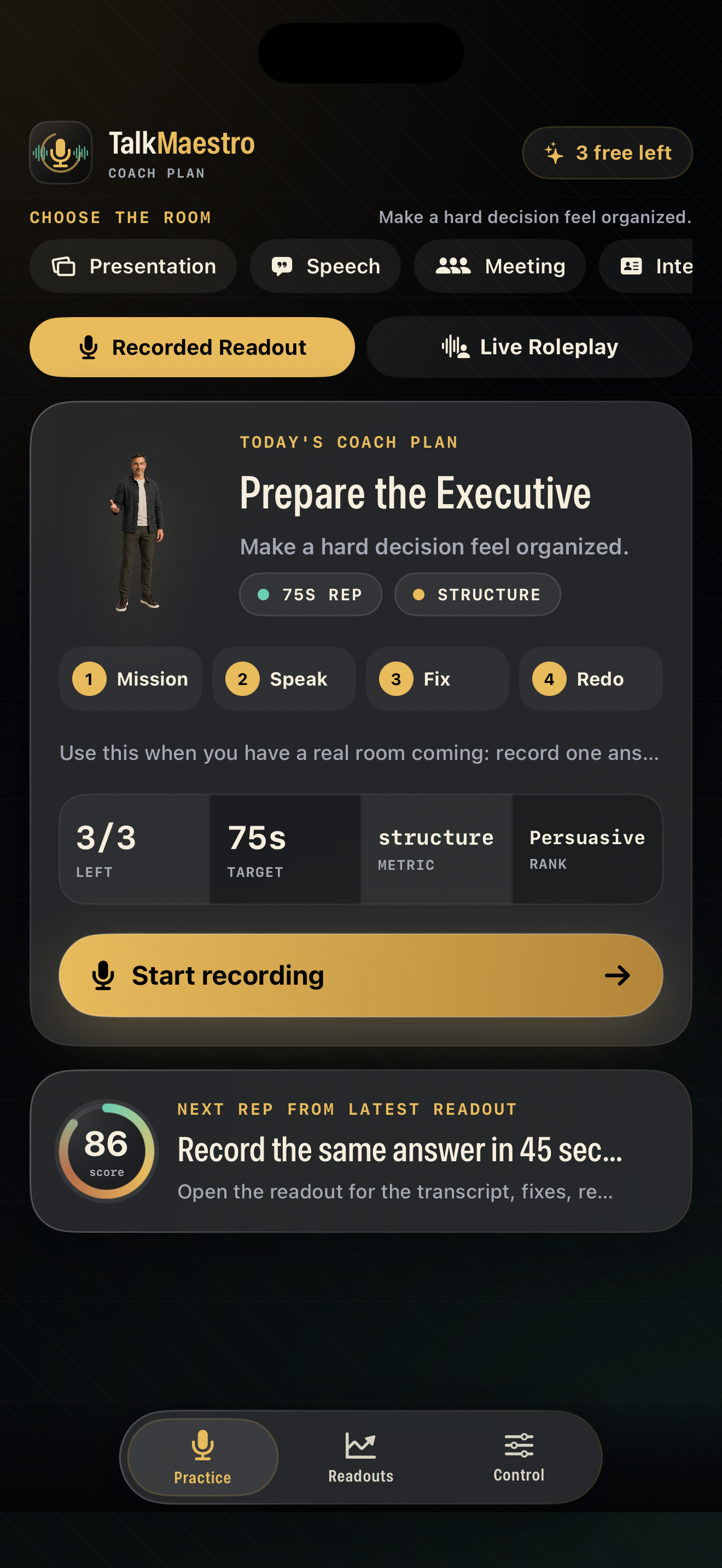
One answer. One fix. One stronger redo.
Rehearse a Two-Minute Introduction: Script Template and Self-Review Rubric
Practice a clear two-minute interview and presentation introduction. Copy the template, record a full take, check pace, clarity, structure and filler words, then redo one line stronger.
A two-minute introduction has one job: make your next 10 minutes easier to follow. Use this template, record one full take, review four signals, then redo a single stronger line.
Most rambling introductions are not a confidence problem. They are a structure problem. You start at the beginning of your career, add every detail just in case, and run out of time before you say why you are here now. The listener hears a timeline when they needed a reason to keep listening.
This drill fixes that. Write a 150–180 word intro, say it out loud in one take, review pace, clarity, structure and filler words, keep one strength, fix one weakness, then say it again.
That is the TalkMaestro method: one answer, one fix, one stronger redo.
The 4-beat template (about 120 seconds)
Use this order. Thirty seconds per beat keeps you near two minutes.
- Present — who you are now in one sentence. Role, context, what you do.
- Proof — one concrete result from the last 1–2 years. What changed because of your work.
- Bridge — why this interview, pitch, or presentation, why now. Connect your proof to their problem.
- Plan — what you want to cover next. Give them a reason to ask a good question.
Copy this skeleton and fill in the brackets:
“I’m [role] at [context], where I [core work]. Recently I [one result + measure if you have it]. I’m here because [their need] and I’ve done [relevant part] before. It would help to start with [topic A], then [topic B] — where would you like to begin?”
Hypothetical example — a labeled illustration, not a customer story:
“I’m an operations analyst at a regional retailer, where I run weekly replenishment. Recently I cut stockouts on our top 40 items from 9% to 3% by rewriting the reorder checklist. I’m interviewing for this planning role because you’re consolidating two warehouses, and I’ve done that cutover before. It would help to start with how I kept fill rates stable during the move, then how I train store staff — where would you like to begin?”
That is 112 words, about 50–60 seconds at a calm pace. Add one sentence of context per beat and you land near two minutes. Do not memorize word-for-word; remember the four beats. A memorized script sounds recited, and one forgotten word can collapse the whole take. Beats survive nerves; scripts do not.
How to rehearse it in one session
- Choose the room. In TalkMaestro pick Interviews for a job intro, Presentations or Pitches for a stage intro.
- Speak the real answer. Record one complete take without pausing. No editing mid-sentence — the room never lets you restart, so practice should not either.
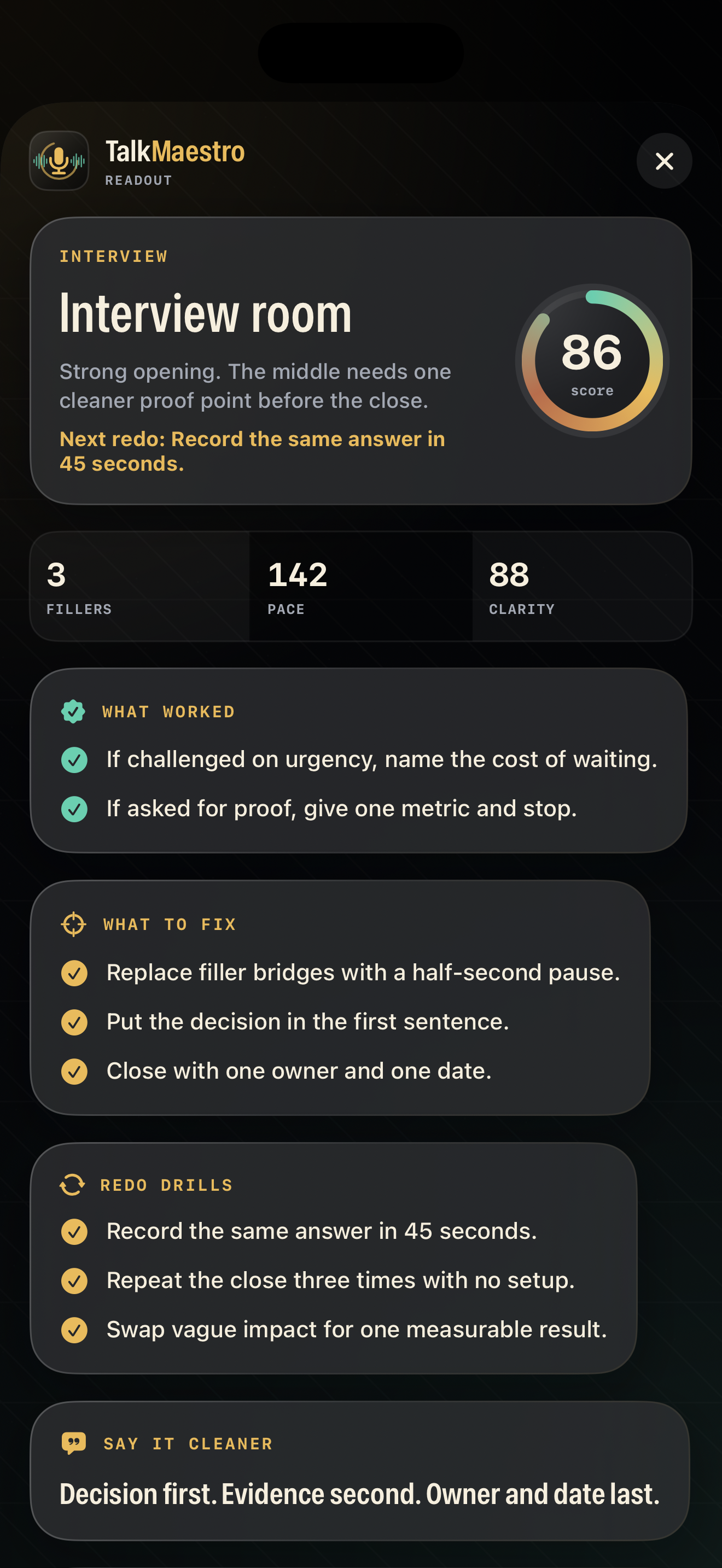
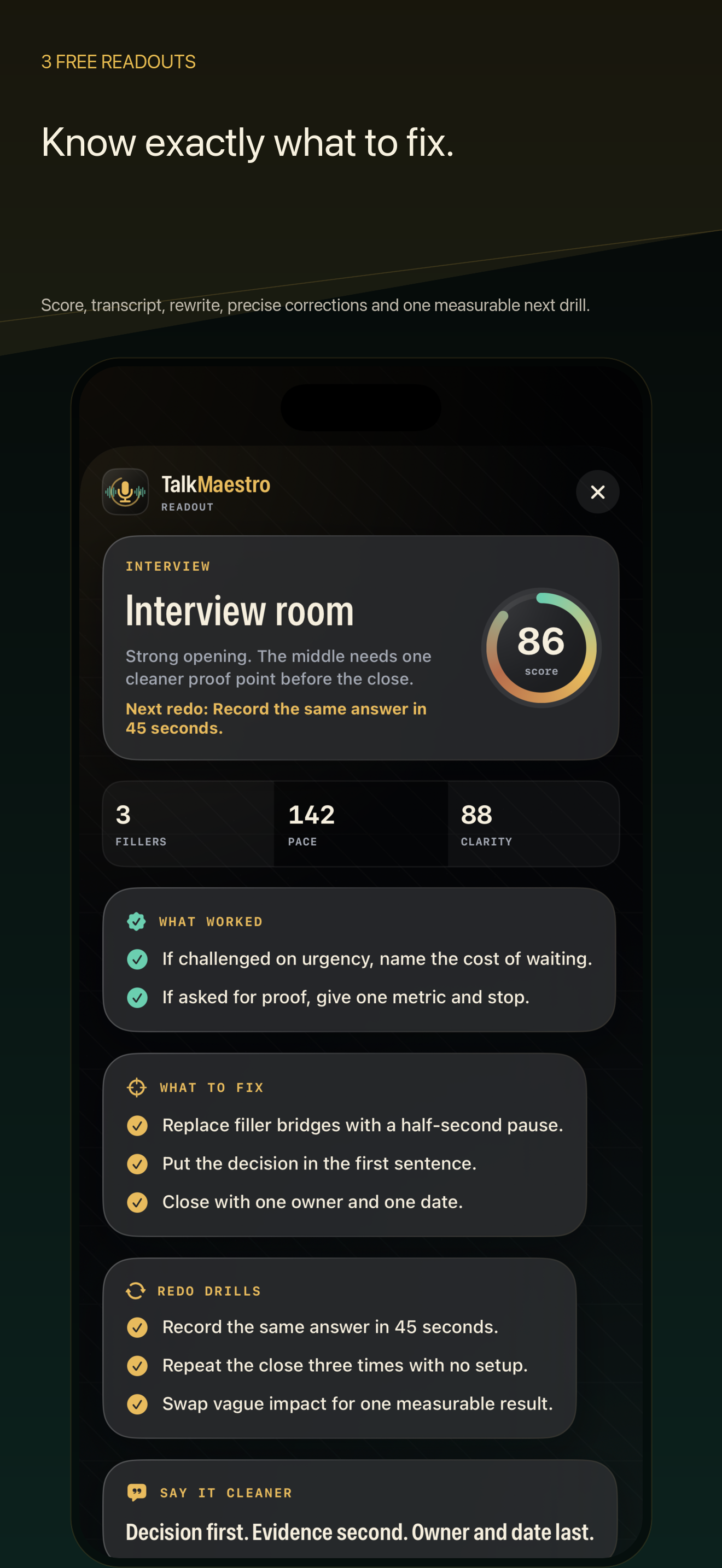
- Read the readout. Look at pace, clarity, structure, filler words, and the transcript. See what the room will hear, not what you meant to say.
- Keep one fix. Take the one precise correction and the suggested rewrite line. Ignore everything else for now.
- Redo it while fresh. Record the same intro again immediately, using the rewrite for the weakest sentence only.
Learn every readout signal here: See every readout metric. For pace help: Speaking pace guide.
Self-review rubric — same four signals the coach checks
Score each 1–3 after your take. Aim for 2 or better before you stop.
- Pace — 3: calm, pauses at commas; 2: mostly steady, one rushed patch; 1: racing or long stalls. Fix: mark two breath spots in your script.
- Clarity — 3: every sentence has a verb and a point; 2: one tangled sentence; 1: listener must guess meaning. Fix: split the longest sentence in two.
- Structure — 3: present-proof-bridge-plan all heard; 2: one beat missing; 1: list of history with no ask. Fix: add the missing beat sentence verbatim.
- Filler — 3: 0–2 fillers; 2: 3–5; 1: filler every sentence. Fix: replace opening “So basically…” with silence.
Transcript test — read it once. If a stranger could underline your result and your ask, you pass.
If you score 1 anywhere, redo only that 30-second beat. Do not re-record everything five times. Five full re-records teach you to dread the drill; one targeted redo teaches you the fix.
Make it fit your room
- Job interview: end with an invitation, not a summary — “where would you like to begin?” hands the interviewer a good next question. See Job interview guide.
- Sales pitch: make proof about the customer outcome, not you. Swap “I cut stockouts” for “the customer stopped running out.” See Sales pitch guide.
- Presentation: replace “where would you like to begin?” with “Here’s what I’ll cover in the next ten minutes.” A stage audience cannot answer back, so give them the map instead. See Presentation guide.
What this practice does — and does not do
TalkMaestro is a private rehearsal environment for iPhone. You choose a practice room and record inside the app; it does not record real calls or meetings, evaluate hiring decisions, or guarantee interview, sales, or presentation results. The iPhone app is free to download; Pro readouts, Live Coach roleplay, missions and progress memory are paid in-app through Apple, with storefront terms confirmed in the App Store before purchase.
Next rep: write your 4 beats in 6 minutes, record take one today, then redo the weakest 30 seconds.
Frequently asked questions
How long should a self-introduction be?
About two minutes — roughly 150–180 words at a calm pace. Four beats of 30 seconds each keep you near two minutes without memorizing word-for-word.
Does TalkMaestro record real calls or meetings?
No. It is a private rehearsal room: you record a take inside the app and get coaching feedback. It is not a call recorder, hiring evaluator or meeting-surveillance tool, and feedback is not a guarantee of interview, sales or presentation results.
How much does TalkMaestro cost?
The iPhone app is free to download. Pro readouts, Live Coach roleplay, missions and progress memory are paid in-app through Apple, with storefront terms confirmed in the App Store before purchase.